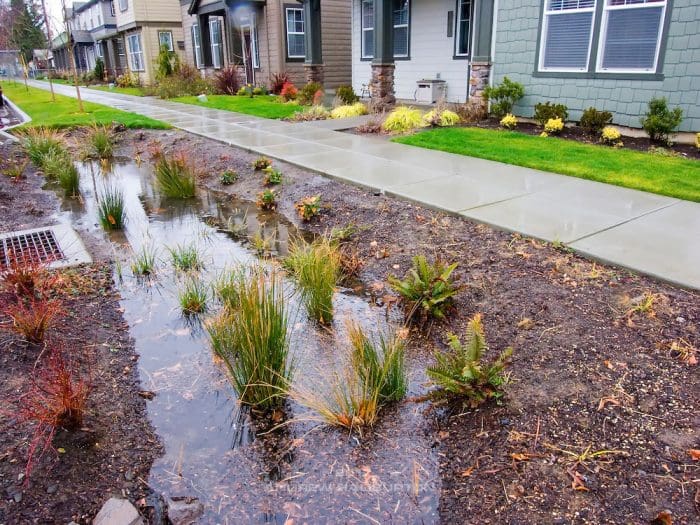
Rain falls often in our community. But where does all that rain go? And when does rain become stormwater? This article takes a closer look at what happens after the rain falls.
Where does rain go?
That depends on what surface it lands on. When rain falls on plants and tree leaves, some of the water evaporates back into the air, and some drips down to soak into the ground. When rain lands directly on the ground, it sinks into the soil, where gravity pulls it deeper and it is stored as groundwater.
If the soil is already full and has no space for more water, rain can form puddles. These puddles may evaporate or slowly soak into the ground over time. When there is too much rain for puddles alone, water begins to flow across the surface, forming small streams that move downhill. As these streams meet at low points in the landscape, they join together to form larger streams, which eventually become rivers or lakes.
In a natural system, rainwater has three main pathways:
- It can evaporate back into the atmosphere.
- It can soak into the soil and become groundwater.
- It can remain on the surface and move through a network of puddles, streams, creeks, rivers, and lakes.

What is “stormwater”?
The term stormwater refers to rainwater that stays on the surface and flows across the land. In natural landscapes, stormwater is managed by plants, healthy soils, and streams. These systems slow the movement of water, allow it to recharge groundwater, and safely carry excess water through streams, lakes, and rivers to the ocean.
But what happens when we build homes, roads, businesses, and parking lots?
Hard, impervious surfaces like roofs and pavement prevent rain from soaking into the soil. Instead, rain runs off all at once. In the City of Lake Oswego, stormwater from these surfaces is collected in pipes that empty into ditches and streams. When you see water flowing from the street into a storm drain, that water is headed directly to a creek.
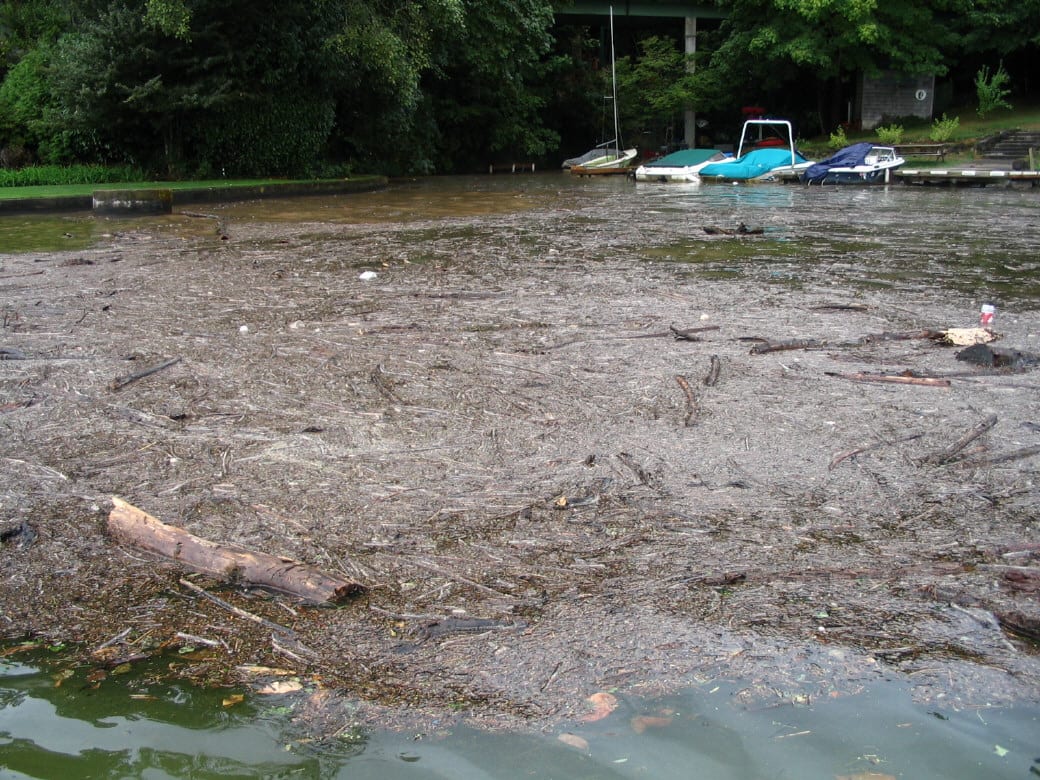
Because this water cannot soak into the ground and be released slowly, it rushes into streams during storms. This fast-moving water erodes stream banks, deepens channels, and carries soil downstream into Oswego Lake. After storms end and flows slow, eroded sediment settles on streambeds, covering important habitat for fish and other aquatic life.
Springbrook Creek Mouth storm event
8-22-2004
Stormwater and pollution
As stormwater flows across impervious surfaces, it picks up “stuff” along the way. This can include dirt, debris, and chemicals. Some pollutants dissolve completely in water and travel with it all the way to streams, lakes, rivers, and eventually the ocean. These pollutants include pet waste, chemical fertilizers and pesticides, fluids from car engines, and tiny particles from tires and brake linings.
Anything applied to roofs, streets, and gardens, or dumped into a storm drain, has the potential to end up in our local waterways.
Because urban stormwater carries so much pollution, municipalities are required to monitor water quality and take steps to reduce harmful impacts. The Oregon Department of Environmental Quality issues stormwater permits that establish Total Maximum Daily Loads (TMDLs), which define how much pollution is allowed in order to protect water quality.
What can you do?
The good news is that managing stormwater isn’t limited to cities and agencies. Simple actions at home and in our neighborhoods can help protect local streams and lakes:
- Slow the flow: Use rain gardens, native plants, and permeable surfaces to help water soak into the ground.
- Keep it clean: Pick up pet waste, use fertilizers and pesticides sparingly, and never dump anything into storm drains.
- Reduce runoff: Disconnect downspouts where possible and direct water onto landscaped areas rather than pavement.
- Protect soil: Maintain healthy vegetation and mulch to prevent erosion.
To learn more about protecting stormwater, visit the City of Lake Oswego’s Surface Water page or explore additional resources on the OLWC website:
https://www.ci.oswego.or.us/publicworks/surface-water