by Deanne Crone Knipple, Oswego Lake Watershed Council Executive Board Member
As spring begins to emerge, you may notice new leaf buds and flowers, increased birdsong and nest-building and more water flowing through your local creek toward the Willamette River. You may have commented to a neighbor about the fresh scent after a recent rain or excitedly pointed out a salamander or fiddlehead to a child in your life. Each of these everyday experiences demonstrates a personal connection to our ecosystem.
This article is the first in a Neighbors for Nature series, hosted by the Oswego Lake Watershed Council (OLWC), where we consider how we are part of our complex ecosystem, as well as our collective responsibility to recognize our impact on that system. Stewardship of our watershed is neither abstract nor distant. It is local and shared. Our community’s quality of life depends on a healthy, resilient ecosystem.
An ecosystem is an interconnected community of living things and the physical environment. It includes plants, people, animals, insects, air, water, soil, fungi, and microscopic organisms. People and our homes are crucial parts of ecosystems, not separate from them.
Healthy ecosystems provide essential benefits, or “ecosystem services”. These include water and air filtration, reduced flooding and erosion, shade that lowers heat island effects, carbon sequestration, wildlife habitat, even enhancement of our physical and mental health. Ecosystems that are cared for with intention become more resilient. They are better able to provide these benefits to the communities that depend on them. Resilient ecosystems recover better from environmental stress such as the record-breaking heat dome of June of 2021 or the ice and windstorm of June 2024.
The health of our ecosystem is directly tied to a community ethic of land and water stewardship, whether on public or private land. If our community ethic is to care for the natural systems around us with thought and purpose, we help maintain the balance that sustains all life, including our own. When natural systems, such as land and water, are neglected, the balance is disrupted, making it harder for ecosystems to survive and thrive.
Every person can contribute to caring for our shared ecosystem. Stewardship does not require dramatic efforts or major sacrifices. Instead, meaningful progress often comes from simple, everyday choices and small actions of stewardship repeated over time, in backyards, along streets, and in public spaces. OLWC helps support this collective action by serving as a bridge between nature, the community, and local decision-making.
There are numerous watershed councils, similar to OLWC, throughout Oregon. These are non-profit, community-based, non-regulatory organizations. Each council works in service of sustaining and enhancing their shared watershed. A watershed is an area of land where all precipitation and water resources eventually drain into a common body of water. We all live in a watershed! If you are curious about the boundaries and health of the watershed associated with any address, check out the EPA’s “How’s my Waterway” tool. Additional resources and data are available through the Oregon Watershed Enhancement Board website.
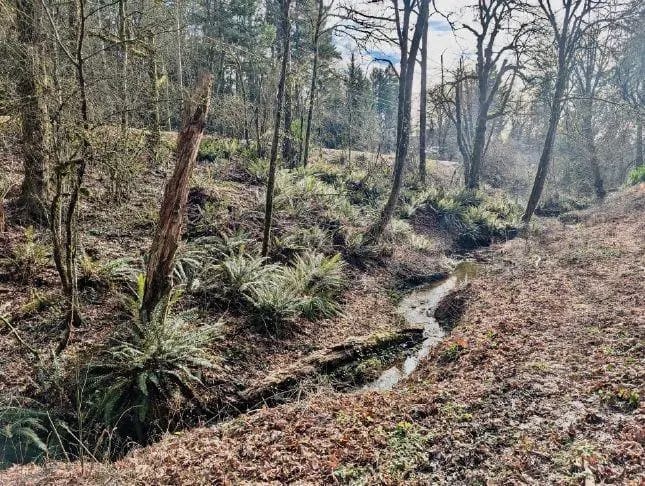
Oswego Lake Watershed Council was established in 2011 by a group of concerned local residents. Over the years, its influence has grown to include multiple habitat restoration sites, educational field trips for every second- and fifth-grade classroom in the Lake Oswego School District, and an annual Urban Forest Summit open to the public. OLWC’s recent and current habitat restoration projects focus on removing ecologically disruptive plants such as English ivy and Himalayan blackberry, then replanting with native species plants. For example, planting native sedges, dogwood shrubs, and willow trees along Springbrook creek in Mountain Park helps stabilize streambanks, reduce runoff, and improve water quality as the water flows toward Oswego Lake and the Willamette River.
No single person or organization can restore or sustain an ecosystem alone. Healthy watersheds depend on long-term, community-wide participation. Collective action recognizes that individuals (and organizations) can contribute in different ways. When shared goals are paired with coordinated efforts, the impact is greater and longer lasting.
More information about OLWC and how you can support our shared ecosystem can be found at https://www.oswegowatershed.org/. Each activity represents an opportunity to contribute to the health of our watershed through collective action. Volunteering for work parties, attending events, joining watershed walks, using ecological best practices in your own spaces, and supporting OLWC are great ways to turn inspiration into action. Specialized expertise is not required. In fact, if you join an OLWC work party, on-site training and any necessary equipment are provided. Sign up for the OLWC newsletter or follow @oswegowatershed on social media for local ecosystem updates, event announcements, to see restoration in action, and learn how to get connected and get involved.
We recognize current and future generations will inherit the outcomes of today’s everyday choices and actions. A healthy ecosystem is within reach and can be built through shared care. Active land stewardship is something we can do together for the collective benefit of ourselves and the land we share with all living things.
Future articles in this Neighbors for Nature series will explore new topics, projects, and practical steps to support our ecosystem. If you have suggestions for future content, please reach out via The Review or OLWC.