
Since launching the Pecan Creek Beaver Habitat Restoration and Education Project, the Oswego Lake Watershed Council (OLWC) has made meaningful strides in both habitat restoration and student engagement. What began as a vision to restore riparian health and support beaver habitat is now an active, hands-on learning site where ecological concepts come to life. This project is made possible through partnership with the Cook Family, the City of Lake Oswego, and the Lake Oswego School District, with funding provided by a donor through the Oregon Community Foundation.

This work was recently highlighted in the Lake Oswego Review, which featured Lakeridge High School students actively restoring the Pecan Creek area, underscoring the real-world impact of student involvement in watershed health
Since the start of the academic year, 13 classes from Lakeridge High School have participated in on-site field experiences, contributing directly to restoration efforts. Students have worked to remove invasive species such as blackberry and yellow flag iris, helping reduce competition for native plants that are critical to healthy stream ecosystems. In their place, students have planted native tree stakes, including willow, alder and other riparian species, that will stabilize streambanks, provide shade, and offer future food and building materials for beavers.
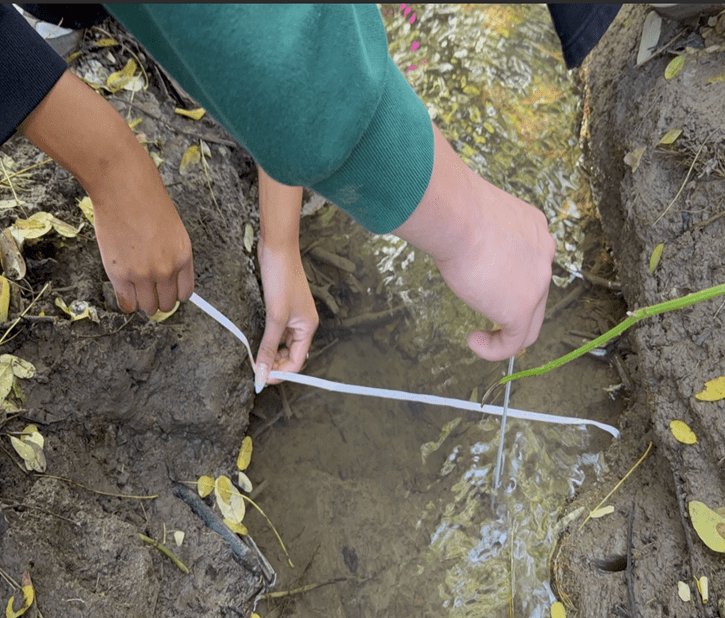
Beyond restoration, students have taken on the role of field scientists. They’ve conducted stream flow monitoring, collected data, established photo monitoring, and mapped the project area to better understand site conditions. As part of this process, students have also looked for signs of beaver activity and evaluated what makes suitable beaver habitat, connecting classroom learning to real-world ecological dynamics


In an exciting development, signs of beaver presence have already been observed in the area since the project began. Evidence such as gnawed vegetation and other habitat indicators suggests that beavers may be exploring the site, an early and promising signal that restoration efforts are moving conditions in the right direction.


These experiences are building a deeper understanding of how beavers function as a keystone species. By slowing water, creating wetlands, and improving habitat complexity, beavers play a critical role in watershed restoration, benefits students are now witnessing firsthand at Pecan Creek.
This project continues to demonstrate the power of combining restoration with education. As the site evolves, so too does student knowledge and investment in watershed health. With ongoing stewardship and community involvement, Pecan Creek is steadily becoming a more resilient ecosystem and a living classroom for the next generation of environmental stewards.
As a long-term restoration and education effort, this project will continue to evolve over time, and OLWC looks forward to many years of collaboration with partners, students, and the community to support a healthy, resilient watershed.