
Written by Rio Hybert-Zack, OLWC Restoration Coordinator
The most important fact that you can learn about our native Oaks is that they do not exist alone. Across their whole range all these places share a biodiversity that is astounding! There are up to 700 plant species, 100 birds, 800 insects, and more than 100 species at risk that rely on this Oak species. Many of these species make up diverse and rich habitats that are only able to thrive because of White Oaks. In this article I hope to invite you into the world of Oak trees as you’ve never seen it before; a vibrant community is waiting for us when we come to know these magnificent trees.
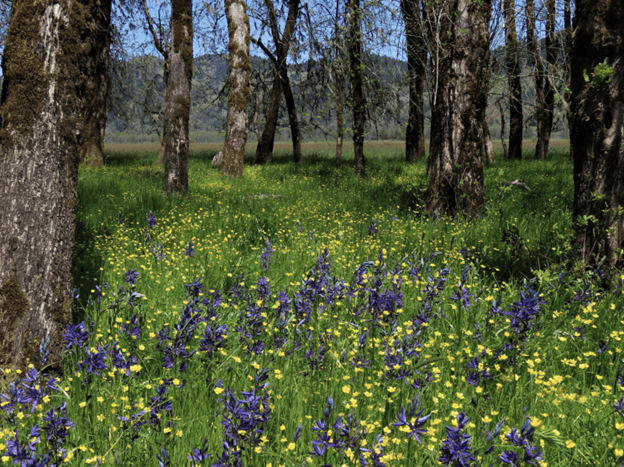
Across the world Oak trees seem to hook people if they get to know them. I can speak of catching a fascination with Oak trees myself. I am one of the many advocates who came to recognize the irreplaceable role our native Oak plays in our ecosystem. Having grown up in the Midwest, Oaks seemed to blend in with the plethora of other deciduous trees all around the same height. When I moved to Portland it had more ecotypes, the mountainous west, the fertile central valley, and the arid high deserts in the east. Oregon White Oaks have large and more distinct canopies compared to the vast Doug Fir and conifer forests that fill in the mountainous region. Our Oak is unique; they are constantly seeking out a living in the valley while the fast-growing conifers, which quickly overtop the shorter Oaks effectively killing them, spread down from the mountains. These trees have been helped by humans, native tribes have cared for the oaks with fire, effectively thinning out the encroaching conifers.
The battle for a place to live and the reciprocity of plants and animals is the core of this Oaks story. There have also been many modern human impacts resulting in big changes occurring with the introduction of western agriculture to oak preferred valley habitats. The arrival of white settlers had great impacts on the modern-day Oregon habitat. They cut down Oaks for farm fields, diverted streams and wetlands, and banned the use of cultural fire. This had the effect of reducing Oak habitat down to less than 5% and leaving the population in a threatened state.
Working with Oaks has left me in awe. There always seems to be another fact I discover that adds to my appreciation of them. These trees host up to 200 endemic caterpillars leading to many other insects, birds, and mammals that live and feed on them. Oaks have also been a food source for humans for thousands of years. Our long-shared history with Oaks has led to Oaks being grown and cared for in many places around the world. This illuminates the connection between a community’s practices and the healthy ecosystem it depends on. As a central component of Watershed Councils, stewardship of the land improves the health of not just humans but every species in the system.
The White Oak can live to 500 years old. Imagine the amount of food and habitat a single tree can provide for that long of a time. It can be hard to imagine the many generations of species it hosts. This gives us reason to think outside our own life span to care for Oak trees and habitat for future generations. Too often we have relied on short-sighted thinking which can lead to a bigger mess for the next generation to deal with. Land care, which is an integral part of the Watershed Council programming, begins to break this cycle. Stewardship is not abstract or distant. It’s local and shared. We understand there are disruptive plants, often introduced, that must be removed, but we also think beyond this first step as we ensure the land returns to a healthy state. Most importantly, building a long-term approach into our projects; returning to sites over and over until they reach a state of self-sufficiency in their recovery. We see humans as stewards who can improve ecosystems just as easily as damage them; even the wildest places can benefit from a human touch.
Oaks are important to humans because of the many strong qualities that Oregon White Oak trees have. They are a drought-resistant native, they are an abundant food source, they can thrive in a range of habitats and they are incredibly long-lived. To really understand Oaks we must understand what an ecosystem is and does. An ecosystem is a system that includes all living organisms, plants, animals, people, and the physical environment (land, water); all interacting together as a unit. The defining word here is interaction. Oregon White Oaks create a web of interactions that connects far and wide on the landscape, and are host to much of the diverse life that is central to an ecosystem. Oregon White Oaks serve as the foundational habitat of our local environment, actively facilitating the complex biological relationships that define a functioning ecosystem.
Where do humans fit in these connections? We know trees can provide clean air but we might forget that they do much more. To understand why we have forgotten, we must change our thinking. First, we are all part of a system where plants and animals also live, our ecosystem. This ecosystem relies on exchange not extraction. Thinking of exchange as the trading of resources, we can also think of reciprocity, the care and mutual benefit from a balanced give and take. When we care for the trees, they are giving back to us. In return, they give back services. They can reduce flooding and erosion, clean water, cool neighborhoods, provide mental health benefits, shade bodies of water, provide habitat and serve as a food source for birds and wildlife. Giving back to our natural environments is what we are missing and it is what the Oaks need most. One way we give back is by planting more of our un-vegetated areas to return function to natural areas. We also must plant more drought-resistant native plants that are essential to adapting our environment for the changing climate. As a drought-tolerant species, our native Oak is especially adapted to a climate stressed world.

Call to Action
In order to revive the vital oak, we must begin planting more oaks wherever possible, caring for oaks nearby, and monitoring oaks for signs of health and harmful insects. We can support the health of the oaks we care for by turning off summer irrigation under the canopy (including supplemental watering for any oaks larger than 2 feet), avoiding large limb pruning while removing other trees and plants growing on the trunk or under the canopy. We can improve the habitat around an oak trees by growing native drought-tolerant flowers, grasses and small shrubs (Oaks in your landscape) . These actions may seem small but they build and add to the larger mission of watershed resilience. This mission includes two types of resilience: community and ecosystem. While they both share the capacity to adapt and recover from stressors, the community is social-centric, while the ecosystem is ecologically focused. In the space where these Venn diagrams cross is where the important work of the watershed council lies.
OLWC builds resilience by supporting our community members through education and outreach, surveying local Oak trees, organizing on-the-ground restoration projects, and leading workshops to share resources and expertise. A healthy Oak ecosystem is built through shared care. By connecting individual actions we can have a greater collective impact. Stewardship is something we can do together for the collective benefit of ourselves and the land we live on. Please consider joining us by volunteering at a restoration work site, attending workshops or watershed restoration tours, changing care practices on your property (Oak care sign up) and supporting the OLWC (donate). By caring for healthy oaks today, we are cultivating resiliency through reciprocity. Where together, we can turn the tide toward vibrant, healthy ecosystems led by the most enigmatic trees.