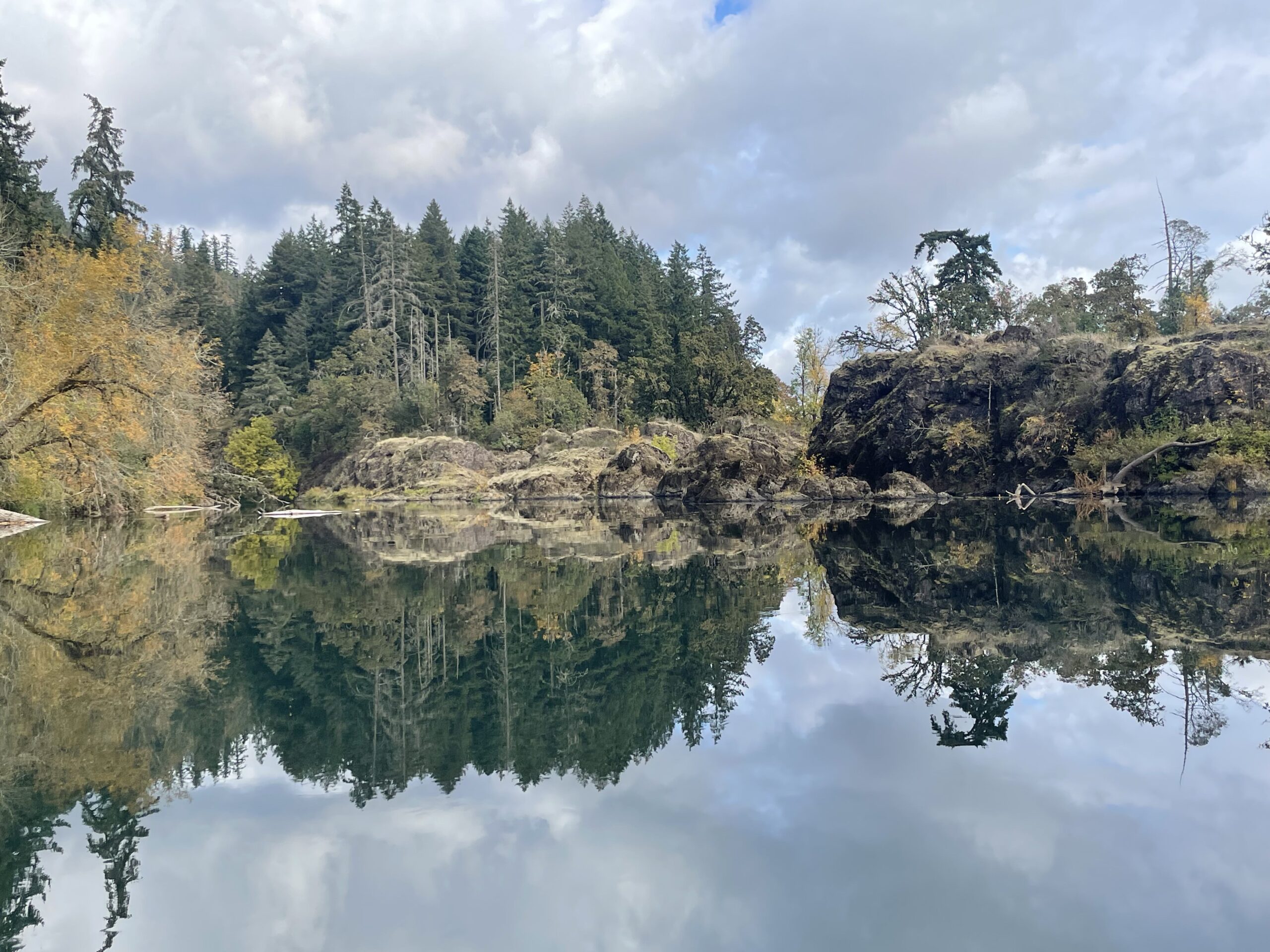
Friends, the rains are back. Our creeks are running higher, the leaves have come down, and the soils are soaking up the water that recharges our groundwater. Plants overwinter by resting and directing their energy toward their roots, which feels just right for this moment. This is our last newsletter as the Oswego Lake Watershed Council, and we’re feeling all of it: pride, gratitude, a little nostalgia, and a whole lot of excitement. Like the land, we’ll spend the winter gathering strength, and in January we’ll emerge as W3, the West Willamette Watersheds Council.
We’re joining with our sister council to the north, the Tryon Creek Watershed Council (TCWC), to form W3. Following two years of collaboration, both boards agreed to the merger this summer, and on January 1, 2027, we officially launch together as W3! We bring 15 years of caring for Oswego Lake’s creeks, oaks, and backyards; TCWC brings 32 years of caring for Tryon Creek and its neighbors. We’re scaling up, and we couldn’t be happier about it.
Why This Matters
Watch any creek this week, and you’ll see it: water doesn’t stop at city limits. Creeks run through our neighborhoods where we live, work, and play, and into the Willamette. The pressures on them keep growing: hotter, drier summers, flashier winter floods, invasive species crowding out natives, emerald ash borer (which kills the Oregon ash that shades many local streams), and 6PPD-quinone, a tire-derived pollutant in road runoff that is lethal to coho salmon. Real climate resilience means caring for the whole landscape.
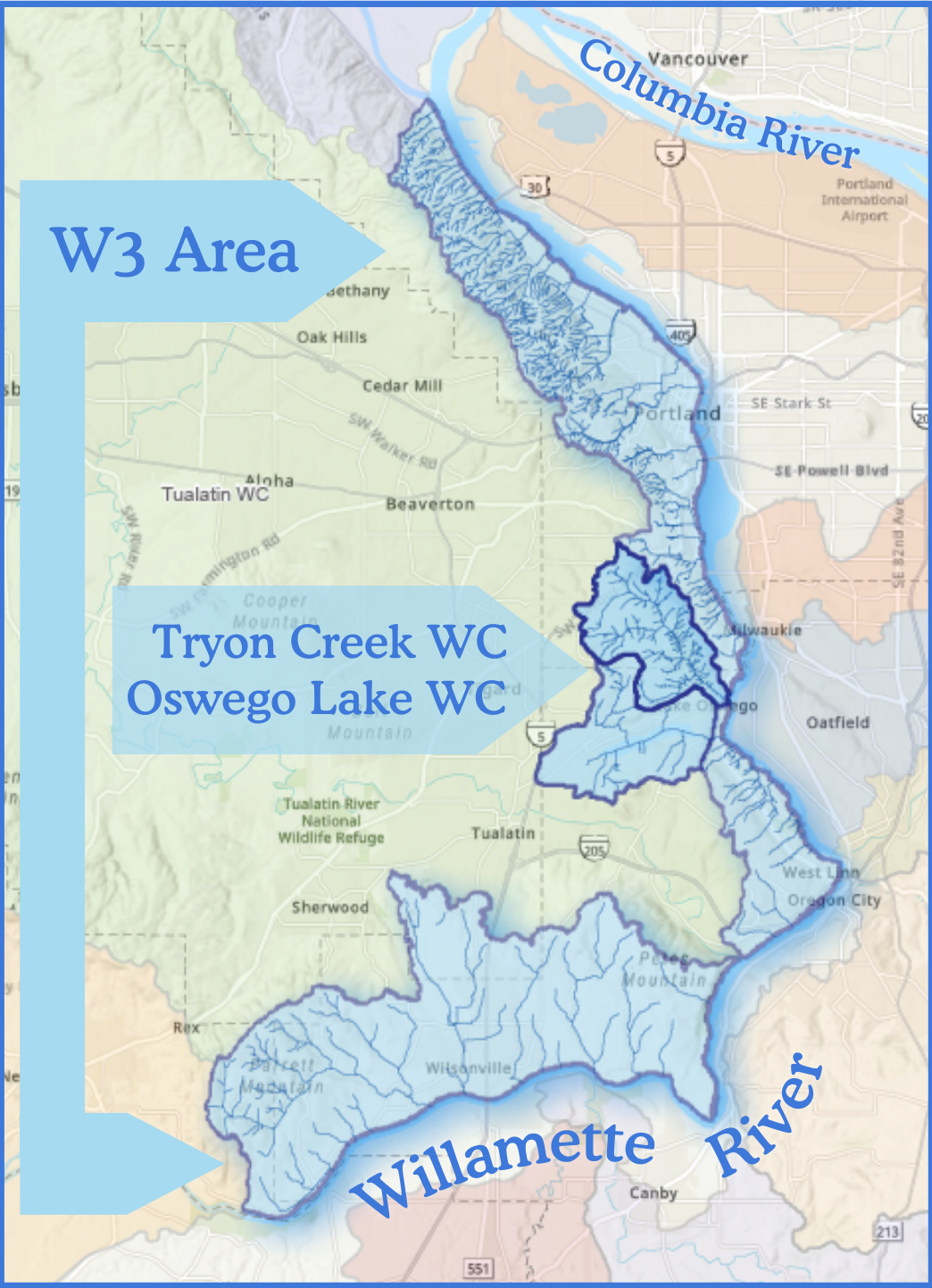
There’s a gap to fill, too. While watershed councils cover about 97% of Oregon’s land, this stretch of the west Willamette is one of the largest remaining gaps. More than 140,000 neighbors haven’t had the resources and services the Oswego Lake watershed has had for the past 15 years. They deserve that care, and so do their creeks.
A bigger organization can have a bigger impact, and we’ll be more competitive for funding from government, family foundations, business sponsors, and individuals. We’ve applied for funding to create a Watersheds Action Plan, a science-based, community-informed restoration roadmap for the full 88 square mile W3 area. This plan will guide restoration priorities and position W3 to secure additional funding for restoration projects throughout the West Willamette.
W3 by the numbers
- 42 miles of the Willamette’s west side, from Forest Park through NW and SW Portland, Lake Oswego, West Linn, and past Wilsonville
- About 88 square miles and 300 miles of streams
- 50 confluences with the Willamette River
- Roughly 500 percent more land area and stream miles
- About 200,000 people served
- 43 species of conservation concern, including federally threatened Chinook, coho and steelhead, and Pacific lamprey
What We’ve Done So Far
We’ve been busy, and honestly, it’s been a joy:
- Seated an early W3 board and are establishing committees
- Started merging staff and systems
- Held community listening sessions across the area this summer and talked with more than 1,000 people. The response was overwhelmingly positive.
- Submitted more than $550,000 in grant applications
- Secured $220,000 so far: a one-time $200,000 appropriation from the Oregon Legislature, plus a $20,000 capacity-building grant from the Ann J. and William Swindells Fund of the Oregon Community Foundation.
- Hosted a November 6 tour with more than 20 legislative officials, agency partners, and press.
- Publicly announced the merger and expansion with a press release last week. Check out the coverage in OPB and Axios Portland!
You Might Be Wondering What This Means for Oswego Lake
It’s a fair question, and one we’ve asked ourselves: will a bigger map pull time and resources away from the creeks right here at home?
The important work continues: Second and fifth grade field trips with the Lake Oswego School District, existing grant-funded projects, stewardship and volunteer work parties, science talks, the Urban Forest Summit, and our Discovering Our Place in Nature Book Group.
Familiar faces are staying. Our intention is to retain the current staff, including Jack Halsey, Rio Hybert-Zack, Max Osovsky, and education staff Megan Hill and Jeanne Wood. Jack Halsey and TCWC’s Alexis Barton Castro will serve as Co-Executive Directors, while Ruth Howell will serve as Development Manager. W3’s board leadership also brings together both organizations, with our current Board Chair Tom Bland serving as Vice Chair, and TCWC Board Chair Glen Leverich serving as the W3 Board Chair.
And Oswego Lake benefits. More shared expertise, more partners, more efficient projects, and a watershed-scale view of the creeks that run through our neighborhoods to the Willamette. Plus, TCWC’s programs will expand to focus on the full geography, including:
- Watershed Wide: TCWC’s annual community restoration day each March, approaching its 18th year, will expand to include sites in newly covered W3 geography.
- Watershed 101: Workshops for landowners and community groups on caring for the land and water in their neighborhoods.
- Science Talks: A lecture series bringing local scientists and experts to the community.
Ways to Get Involved
- Keep reading this newsletter. You don’t need to do anything; you’ll move to the W3 list automatically.
- Join a committee. Lend your skills to one of our important committees, listed below. Email Alexis@westwillamettewc.org to express your interest in:
Watershed Coordination
Education
Community Building
Development & Fundraising
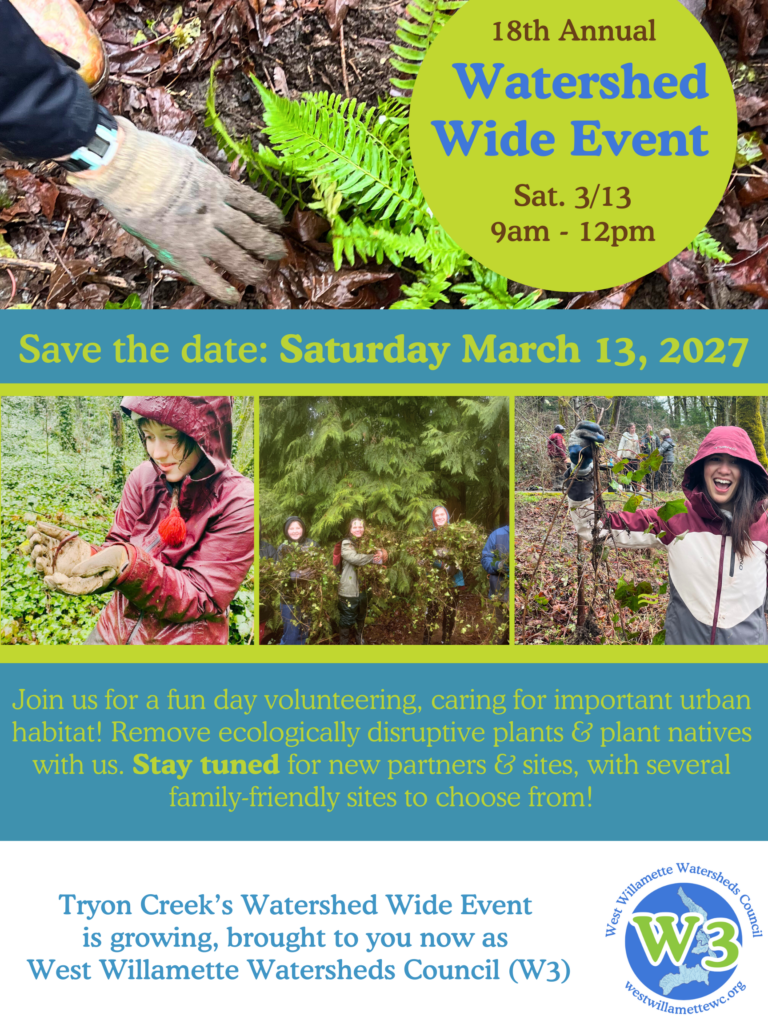
- Save the date for Watershed Wide on Saturday, March 13th.
- Donate! Become a Founding Member. Donate and become a Founding Circle Member. On Giving Tuesday, December 1, we’ll launch the W3 Founders Circle: a three-year pledge starting at $25 a year. Stay tuned for more information.
- Follow us on Instagram and Facebook
- Check out our new website at westwillamettewc.org. There you will find our new vision statement, maps of climate vulnerabilities in the W3 generated by Portland Community College GIS students, and a PowerPoint overview of why W3, why now.
Thank You, and Here’s to What’s Next
For 15 years, you’ve shown up for the creeks in our own backyards: pulling ivy, planting natives, and opening the minds of elementary students. Those are the roots W3 grows from. So while the rain falls and the ground fills back up this winter, we’ll be gathering strength and getting ready to grow. We’re so grateful you’ve been part of OLWC, and we can’t wait to see what the future holds. In December, you’ll hear from us a few times about opportunities to support W3 during the giving season. Then, we’ll see you in January, as W3.