
How Restoration Takes Root in Unexpected Places
Authored by Mike Buck, OLWC Board Member and Stewardship Volunteer
Restoration Project Overview
Our first year of restoration at this site resulted in significant improvements across one acre of the nine-acre natural area. This acre contained the most critical habitat: a small, perennial creek that flows into Lily Bay. Prior to restoration, the creek was becoming deeply incised, largely devoid of native vegetation, and conveying stormwater too rapidly during high-flow events to support aquatic and riparian organisms. Along this key reach of the creek, we removed 10,000 square feet of invasive, non-native species, stabilized and seeded all exposed soils, and planted thousands of native plants.
Steep slopes surround this natural pond, and no access is provided except narrow pathways created by deer. A scheduled spring volunteer work party was cancelled because conditions were deemed too hazardous.
Yes, this unfragmented nine-acre site, half of which is aquatic ecology, has stories unfolding behind this beautiful but formidable “book cover.” To turn the biological and geological pages, a visitor would be aided by a historical lens for truly memorable experiences. A beaver family tried to make this a place of belonging until it dammed up the “wrong place” too close to backyard landscapes and stormwater outfalls. The family was forced to retreat from the Lily Bay tributary to the pond. Last spring, a natural aquatic plant called azolla—nourished by nutrient-rich runoff from the drainage of many nearby houses—covered virtually the entire surface of the pond, and even the ducks chose to find a better place.


However, this is the place I choose to stay – until our mission to improve habitat quality is ready to be turned over to healthy native vegetation and willing neighbors to maintain it. We have 25,000 square feet of selected, preserved but formerly neglected lands here to help improve this year.
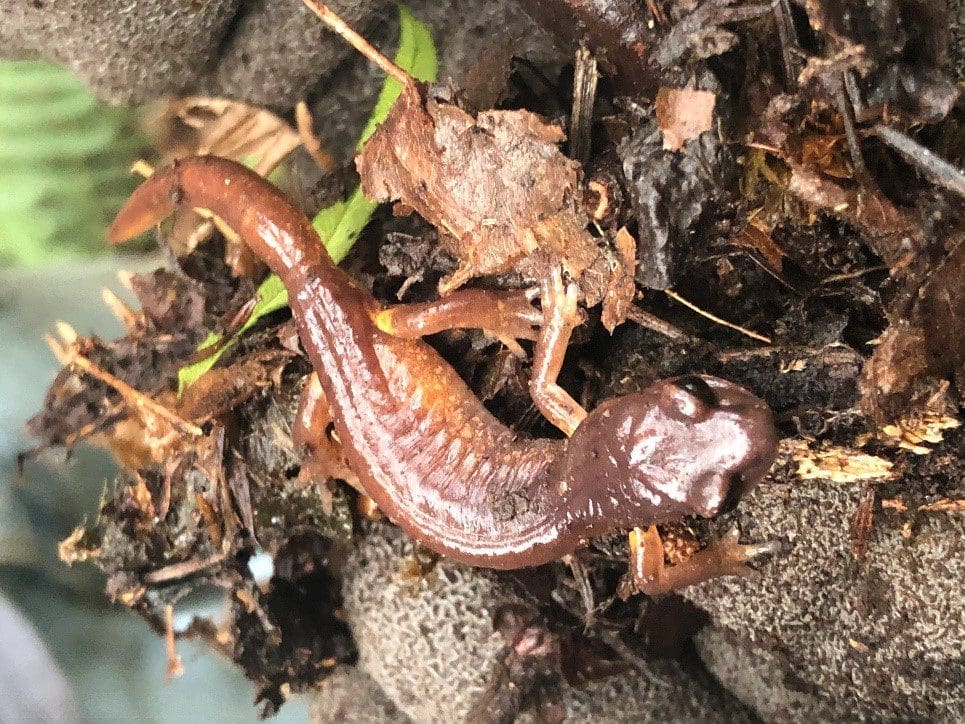
Under the conifers and bigleaf maples, around the vine maples and sword ferns, timid creatures like salamanders stay hidden and vigilant. Deer pass by with a wary landlord mentality. I feel at home, not in danger. Here, life’s mortal story just adds more chapters of newness among the leaning, bent, broken boles and branches. Nature does not have a “program,” and what lives there does not provide “performances.” But flora and fauna make appearances, and colors unfold in arrays that would cause an interior decorator to blush. The designs of feathers, weathered wood, scoriated stone, and ferny fronds delight. Soft and sharp, tender and tough, nature calls one close to discover seedling emergents from winter dormancy and fallen leaves. Removing unwanted ivy saves covered natives like wild rose and snowberry. Last week, I found a small myrtle seeking the rescue of light. In the pond, an undesirable yellow flag iris acts like a squatter. It has not learned how to be a good companion and is forcing out the native lily. We are having it scoot.
I have learned how to be prepared for all kinds of weather. Spiritually, I also know that, with a thankful mindset and a vision that industrializes the will, I can accomplish more. When native plants respond with new growth and vibrancy, I am regenerated also.
Come with the humility of a mushroom, mixed with the outreach of a soaring Douglas-fir seeking heights of light. We hope to find our place for just a little while and then detach and leave it to the creatures that call it home. We are visitors, but not merely spectators. We come as health providers and stewards. Newness replenishes those who dare their vulnerability. Yeah, there is a liability paper to sign for volunteering—that’s the easiest part! Dare to experience this natural treasure!